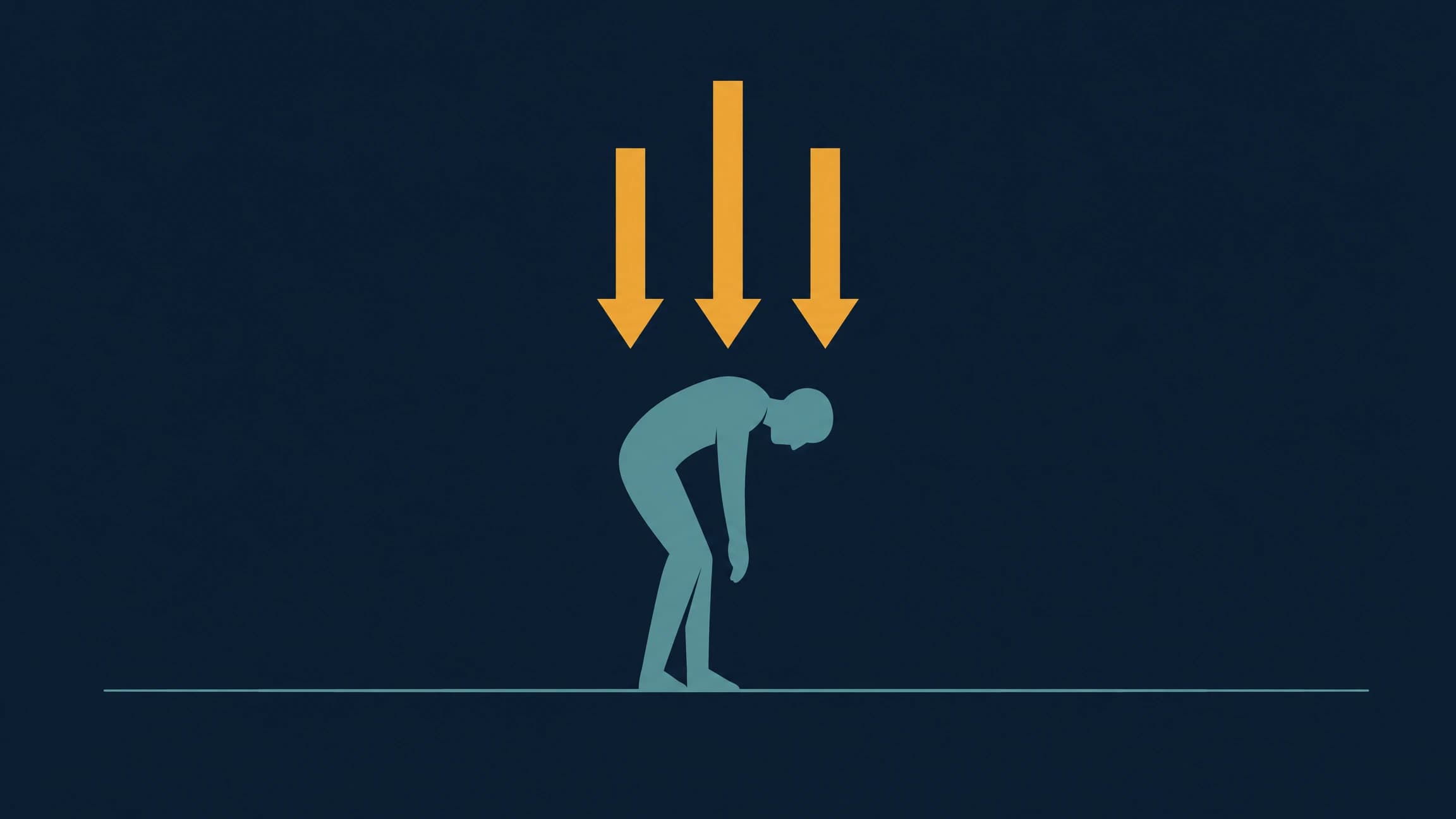
This scenario needs one clarification before the physics gets interesting: 'doubling gravity' most usefully means doubling the acceleration due to gravity at Earth's surface — roughly 19.6 m/s² instead of 9.8 m/s² — without changing anything else about the planet's chemistry or atmosphere. That is not a realistic event we know how to trigger, but it is a useful thought experiment because it isolates one variable that touches almost everything built or evolved around 1g.
The first thing you would notice: everything feels twice as heavy
Mass would not change. Weight would. A 70 kg person would still contain 70 kg of matter, but the downward force from gravity would double. In everyday terms, standing still would feel roughly like carrying an additional 70 kg all the time. Picking up objects, climbing stairs and simply accelerating your own body would require much more force.
What happens to the human body?
The biggest immediate problem is not simply tired muscles. Blood has weight too, so the cardiovascular system would have to create a much larger pressure difference to move blood from the legs to the brain while standing. People would also put greater mechanical loads on their bones, joints and connective tissues. The exact survival threshold cannot be reduced to a single number because posture, fitness, body shape and the speed of the change all matter, but a sudden permanent 2g environment would be an extreme physiological shock.
A sustained 2g load is very different from briefly experiencing 2g during a vehicle manoeuvre, but aerospace medicine demonstrates the underlying principle clearly: increasing effective G-load makes it harder for the cardiovascular system to maintain adequate blood flow to the brain. The response depends strongly on duration, posture and individual physiology.
Would humans survive?
If gravity doubled instantly and stayed there, many people would struggle to stand or move normally, and vulnerable people could suffer serious cardiovascular and musculoskeletal consequences. Survival would not mean that every human dies immediately: some people could remain alive while largely bedridden, and technology could eventually help with mobility and circulation. Over generations, however, human bodies and infrastructure could adapt only gradually, through engineering, behaviour and potentially evolutionary change.
Why large animals would have a much bigger problem
The square-cube law makes body size especially important. As an animal gets larger, its mass and therefore its weight increase roughly with the cube of its dimensions, while the cross-sectional area of its supporting bones increases only with the square. That is one reason large terrestrial animals already face stronger structural constraints than small ones. Doubling gravity would push those constraints in the wrong direction immediately, especially for elephants and other very large animals.
Trees would struggle too
A tree has to support its own mass while moving water upward against gravity. Doubling gravity would increase the pressure needed to lift water through its vascular system and increase the mechanical load on trunks, branches and roots. The exact height limit would depend on species and soil conditions, so it is safer to say that very tall trees would become substantially harder to maintain than to claim that every tall tree would instantly collapse.
Buildings, bridges and infrastructure
A structure's own weight would double, as would the weight of people, vehicles, stored goods and other live loads. Existing safety factors are designed to provide margins against uncertainty and unusual loads, not to guarantee survival after a universal doubling of gravity. Some structures could remain standing; others, especially heavily loaded or already damaged structures, could fail. Engineers would have to inspect and reinforce infrastructure rather than assuming that a simple '2× gravity' multiplier predicts every failure.
Could cars and trains still work?
Cars would not suddenly become twice as massive, but their weight would double. Tyres would have to support more normal force, suspension components would carry larger loads, and braking would become more demanding. Frictional grip can increase with normal force, but so do stresses on tyres, axles and road surfaces. Trains would face similar structural and power challenges, while steep hills would become substantially harder to climb because the component of gravitational force opposing motion would be larger.