Quick Answer
In one sense, dinosaurs are still alive — birds are, by scientific classification, avian dinosaurs, direct descendants of theropods. But if the question is about non-avian dinosaurs like Tyrannosaurus or Triceratops surviving the mass extinction 66 million years ago, the honest answer is that they wouldn't look anything like their Cretaceous ancestors today. They would have kept evolving through 66 million more years of dramatic climate change and continental drift — and their continued dominance might have prevented large mammals, including primates, from ever getting the ecological opening they needed to diversify.
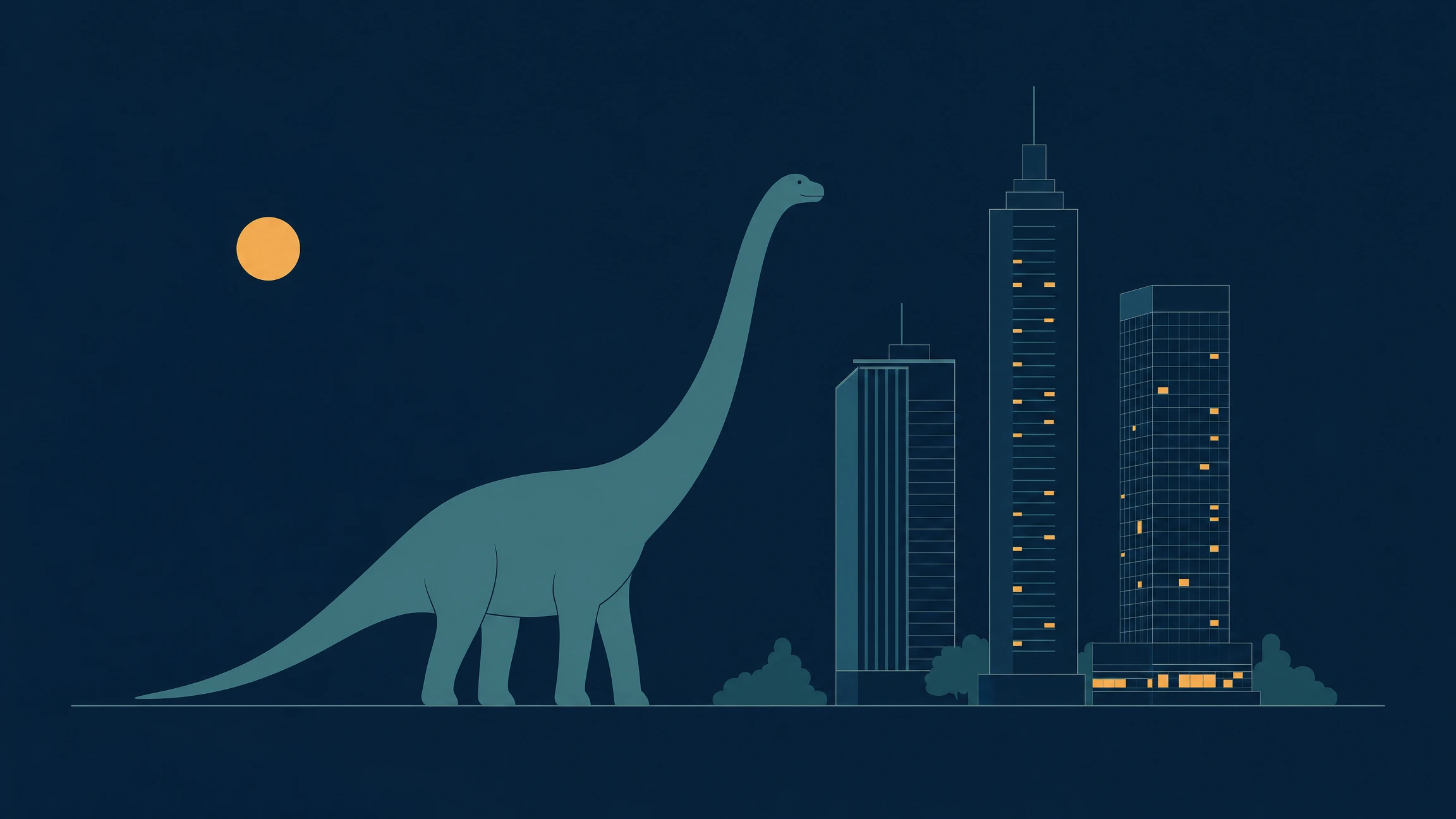
This question usually imagines a T. rex wandering a modern city, essentially unchanged since the Cretaceous. That framing skips the most interesting part of the science: evolution doesn't pause. Any dinosaur lineage that survived the extinction event would have kept changing for 66 million more years, exactly as birds — the dinosaur lineage that did survive — have.
Birds already answered part of this question
Since the 1990s, an overwhelming body of fossil and anatomical evidence — including feathered theropod fossils from China and detailed skeletal comparisons — has established that birds are a surviving lineage of theropod dinosaurs, the same broad group that includes Velociraptor and T. rex. This isn't a metaphor or a simplification; in modern cladistics, birds are formally classified within Dinosauria. So the honest headline answer to 'are dinosaurs still alive' is yes, roughly 11,000 species of them, most currently at bird feeders.
Established scienceThe classification of birds as avian dinosaurs is supported by extensive fossil evidence (including feathered non-avian theropods) and is the mainstream scientific consensus in vertebrate paleontology, not a fringe or contested claim.
What actually killed the rest
The scientific consensus, backed by a global layer of iridium-enriched sediment called the K-Pg boundary, points to an asteroid roughly 10 to 15 km wide striking near what is now Chicxulub, Mexico, about 66 million years ago, releasing energy on the order of billions of times the largest nuclear weapons ever tested. Massive volcanic activity in India's Deccan Traps around the same period is considered a contributing or compounding factor in most current research, though the asteroid impact is regarded as the primary trigger of the abrupt extinction.
If the impact had missed
In a world where non-avian dinosaurs survived, they wouldn't be static. They would have faced 66 million more years of continental drift (the continents were already close to their current positions by the late Cretaceous, but have continued shifting since), multiple significant climate shifts including a period of dramatic global cooling, and the spread of grasslands, which only became widespread starting roughly 34 million years ago in the Cenozoic — meaning even a surviving Triceratops-like herbivore would have had to adapt to food sources that didn't exist in its original Cretaceous environment.
The mammal problem
Mammals existed alongside dinosaurs for well over 100 million years before the extinction event, but stayed small — mostly nocturnal and modest in size, likely due to ecological competition from dinosaurs occupying the large-bodied niches. The rapid diversification of mammals into the large body sizes and forms we'd recognize today happened specifically in the roughly 10 million years after the extinction event, when those ecological niches opened up. Multiple paleontological studies, including work by researchers such as Alroy and O'Leary and colleagues, point to this post-extinction window as the critical opportunity for mammalian radiation.
SpeculativeWhether primates — and eventually humans — would have evolved at all in a world where large dinosaurs kept those ecological niches occupied is genuinely unknowable. It's a reasonable inference from the pattern of mammalian radiation after the extinction, but it isn't a testable prediction; we only have the one timeline to study.
~66 million years ago
K-Pg extinction event
10–15 km
Estimated asteroid diameter
~11,000
Known living bird species today
~34 million years ago
Grasslands became widespread
This scenario also connects directly to several other WhatIfLab questions: removing the Moon would alter tides and Earth's long-term rotational evolution, while doubling gravity would show how sensitive life and infrastructure are to changes in Earth's physical environment.
A timeline with living non-avian dinosaurs
Day one
Modern ecosystems would suddenly contain large predators and herbivores with no established ecological niche for them.
Years
Competition for food and territory would reshape local ecosystems, while humans would adapt around the new animals.
Millions of years
If dinosaurs had survived for tens of millions of years, evolution would have changed them enormously; there would be no reason to expect Jurassic Park versions.
The bottom line
'Dinosaurs are still alive' is already true, in the form of every bird outside your window. The more provocative version of this question — non-avian dinosaurs surviving to the present — would have produced a world so reshaped by 66 million additional years of evolution that it likely wouldn't resemble a single frame of Jurassic Park, and might never have produced a species capable of asking the question at all.